

The Secretary of State for Transport has set a target for rail freight: grow by 40% by 2040, and 75% by 2050, citing supply chain resilience, economic growth and decarbonisation as the desired outcomes.
It would certainly be good to see fewer lorries on the road, giving way to more efficient freight trains. Great move by the Secretary of State.
Except that there is not a single piece of evidence to show how it could be done.
Freight peaked when coal peaked
The thing to understand about rail freight is that it’s very good at shipping things that are required in very, very large amounts, in one place.
Such as: coal.
When Britain was still mining coal, it didn’t have to ship it very far because power stations were located close to the mines. Then coal mining was phased out, but coal-based power generation was not. That meant that coal had to be imported.
And when coal was imported, there was a large distance to cover between the ports and the power stations. That is exactly when freight trains are most useful.
And indeed, 2006/07 and 2013/14 were the peak years for rail freight, and for coal on rail.
In April 2015 the carbon tax on power stations doubled, and coal-based generation fell quickly. And with it, the shipping of coal on trains and rail freight overall.
The new target of a 40% increase by 2040 wants rail freight to go back to what it was in 2013/14. But that peak was only possible due to the unique advantage rail freight had in carrying coal. Surely less rail freight and less coal burnt is better? More freight isn’t always desirable.
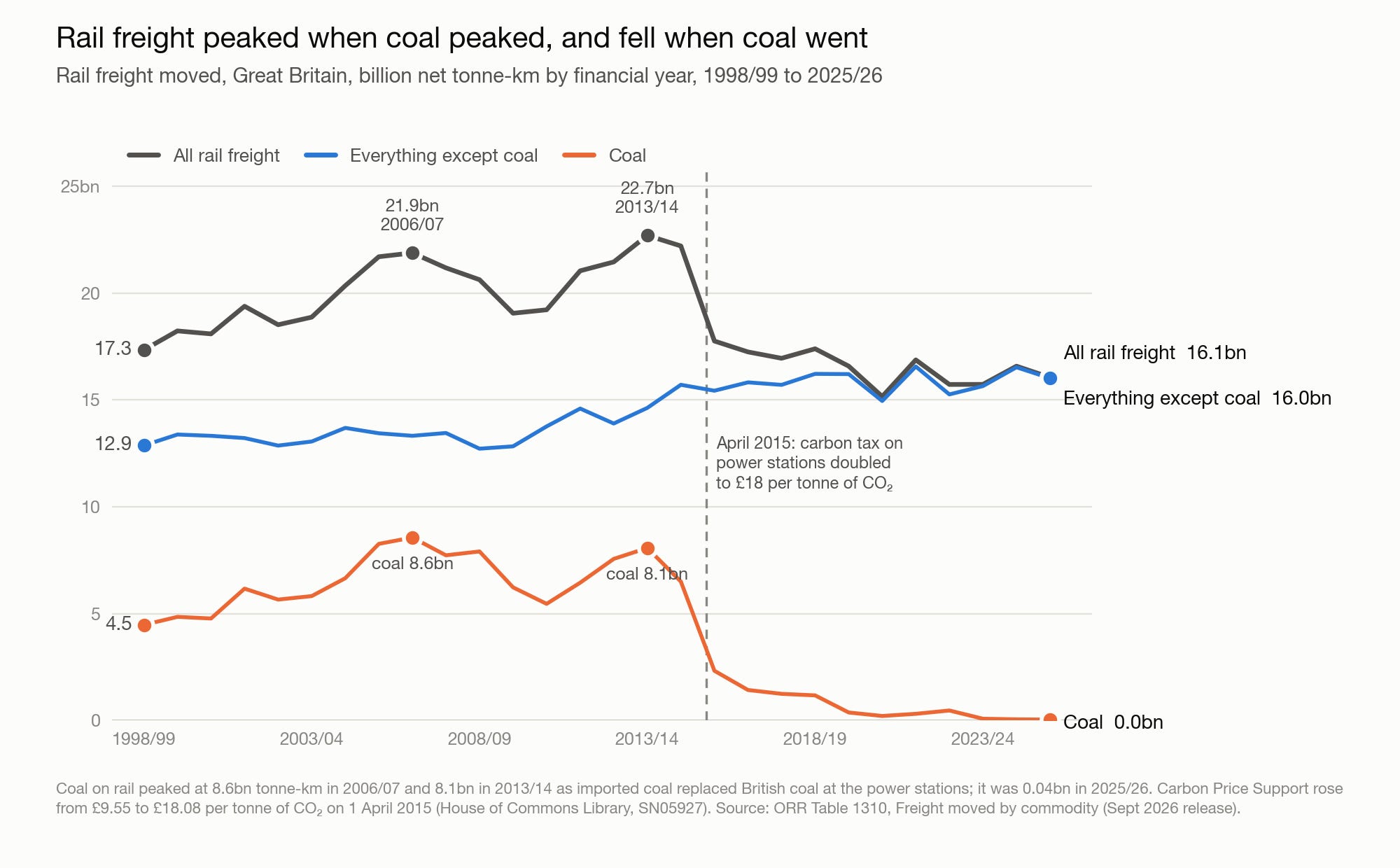
Source: ORR Table 1310, Freight moved by commodity (September 2026 release); carbon price from House of Commons Library briefing SN05927.
Freight declined, but rail kept its share
Between 1998 and 2019 (the last year before DfT changed how it measures road freight), total domestic freight in Britain fell by roughly 13%. Total rail freight fell with it, by 4%.
Rail freight did not fall because lorries took its traffic. It fell because the market declined.
What matters, though, is that the share of rail freight barely changed. Peaks aside, it stayed around 8% of all domestic freight, 10% of road and rail, for twenty years. Everything on rail except coal grew by more than a fifth — faster than road freight.
Keeping its share in a shrinking market should be seen as a success.
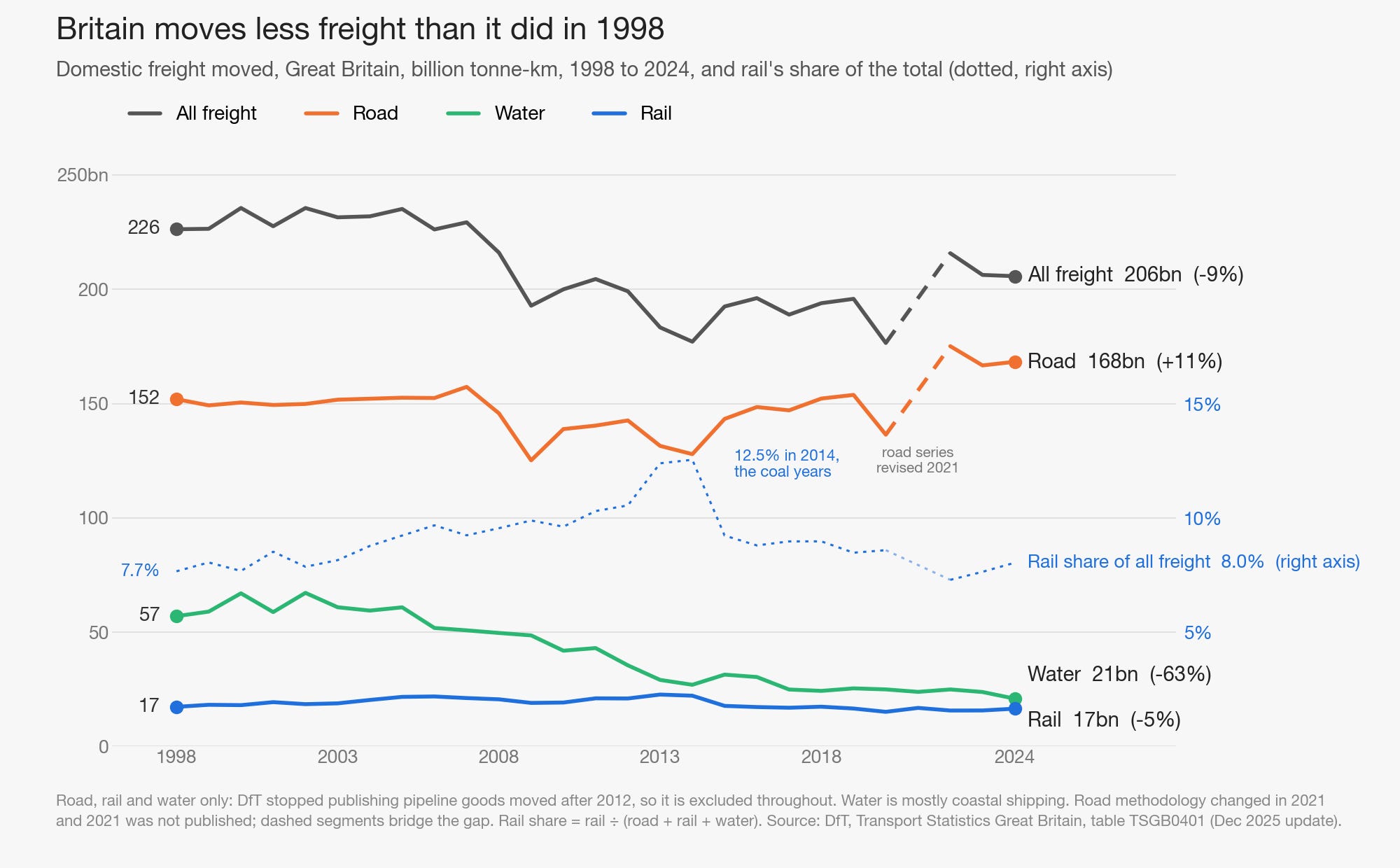
Source: DfT, Transport Statistics Great Britain, table TSGB0401.
It’s the economy, stupid
To understand the performance of rail freight one needs to look deeper into its composition. Alongside coal, metals and oil went down too, while construction, containers and biomass went up.
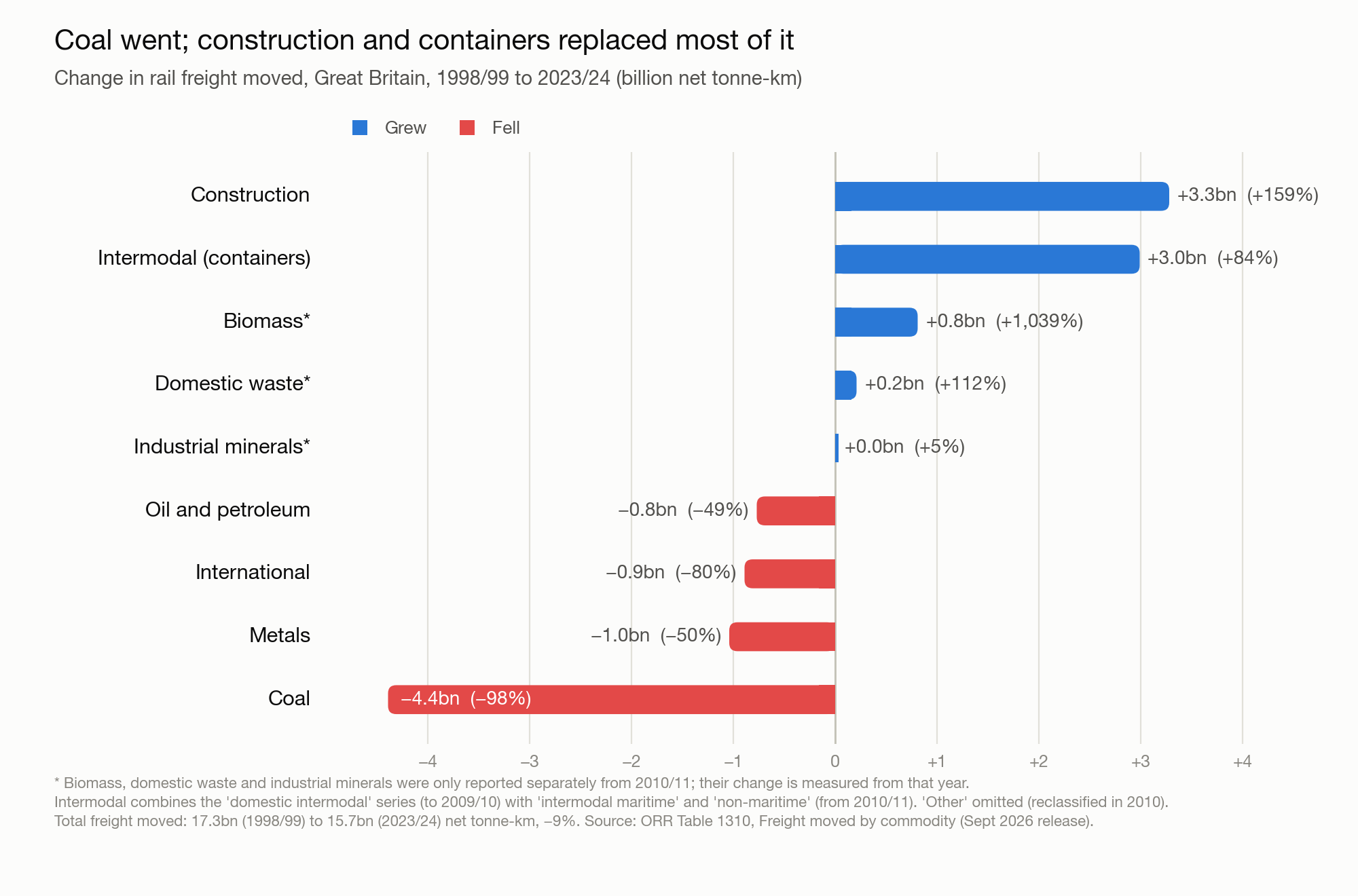
Source: ORR Table 1310, Freight moved by commodity (September 2026 release).
Just as the decline in coal freight reflects a declining industry, so does the decline in the other commodities that went down.
Crude steel output fell from 17.3 million tonnes to 5.6 million over the same period. Oil refinery throughput fell from 94 million tonnes to 51 million.
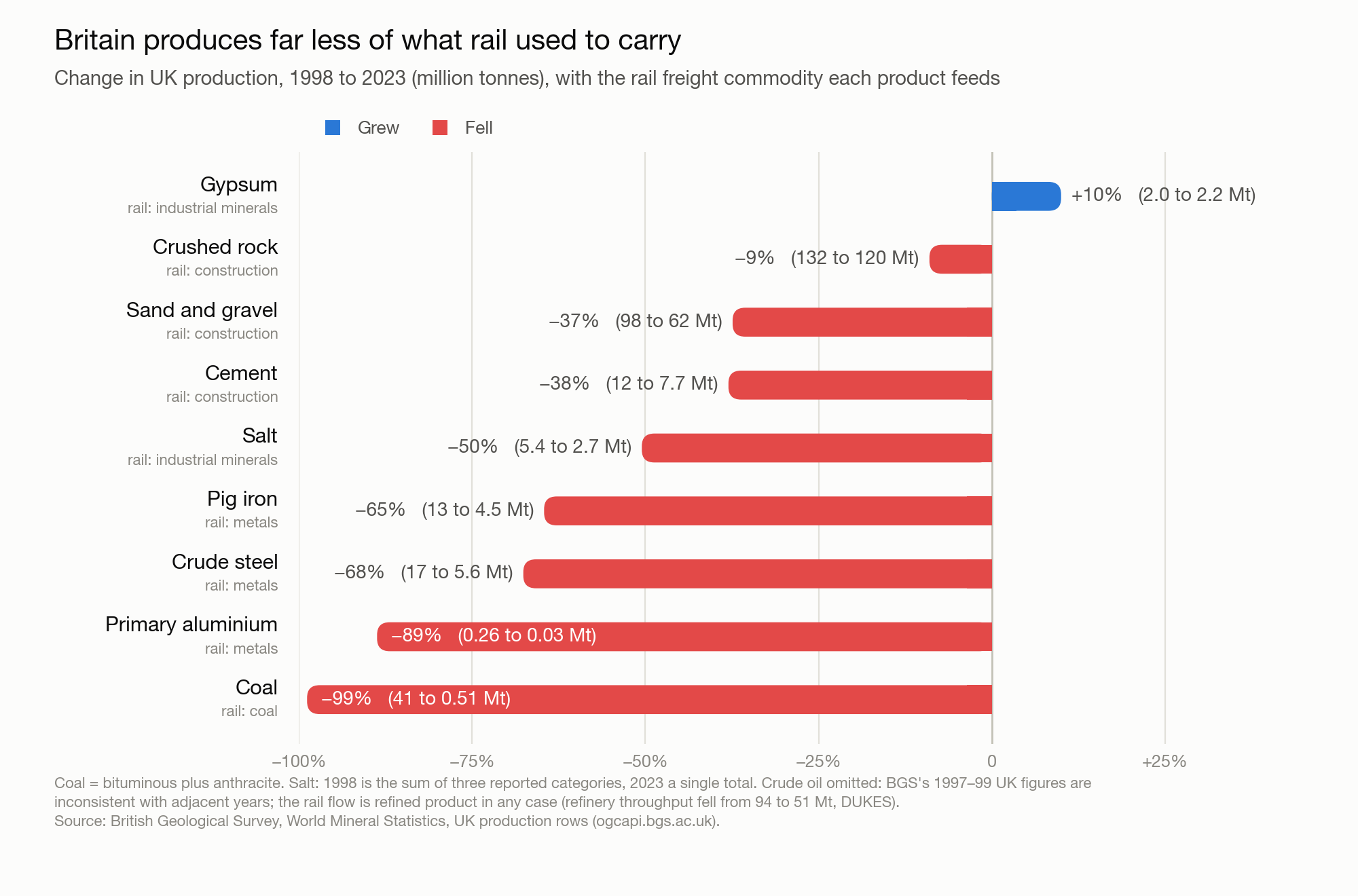
Source: BGS World Mineral Statistics.
While domestic production of construction materials went down, construction output did not. The remaining production probably had to travel further, hence the increase in construction freight.
As far as I can tell from the data, GB rail freight operators know how to capture new markets and respond to structural changes in the economy.
Britain is not alone
Since 2000, rail freight has stopped growing in the US and the EU as well. In their case, however, rail’s share fell while road freight went up.
In the US, the drivers are similar, albeit at a greater scale. Coal was 45% of the tonnage American railroads carried in 2008. But as the US moved from coal to shale gas, coal carried by rail fell by 60%. Rail’s share of American surface freight rose to around 50% in the coal years to 2014, and has fallen to 40% since.
In Europe, rail freight volume has been flat since 2000 while road freight grew by a third. Similar to Britain, coal, oil and metals went down, and container freight went up. The composition changed, and rail’s overall share went down slowly.
Two things are very clear from the international comparison. One is that rail freight is not growing anywhere. The markets it was built for are shrinking, and the markets that are growing suit lorries. It looks like a persistent trend. The ask of GBR, then, seems pretty unrealistic — to not only be a lot better than benchmark countries, but to completely reverse the trend.
Secondly, it looks like there are big gaps in rail’s share between Britain, the US and the EU. The question is, what could explain these gaps? And whether Britain could realistically close them.
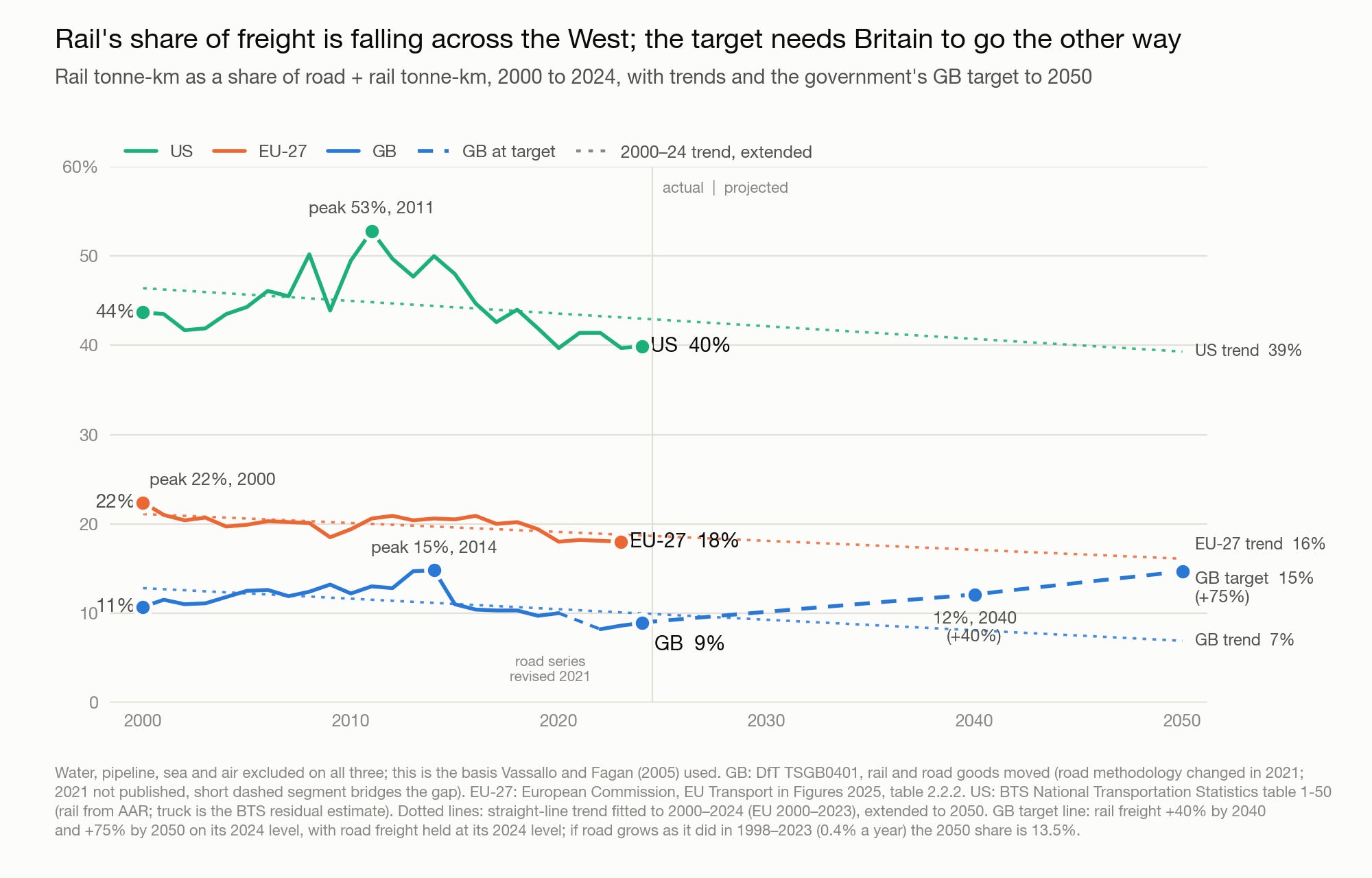
Source: DfT TSGB0401 (GB); European Commission, EU Transport in Figures 2025, table 2.2.2 (EU-27); US Bureau of Transportation Statistics, National Transportation Statistics table 1-50 (US).
Nature or nurture
In 2005 a Harvard working paper asked (almost) exactly that: why American railroads carry so much more freight than European ones do. Measured against road alone, as in the chart above, US rail’s share was 59% in 2000 against 15% in the EU, while both started from the same place in the 1950s. The paper’s road data run lower than the official series, so its levels differ from the chart’s; what matters here is how it splits the gap.
The authors find that about 80% of the gap can be explained by what they call inherent differences — competition from coastal shipping (Europe has nine times America’s coastline), shipment distance (an average haul of 132km in Europe against 386km in the US) and commodity mix — and only 20% by policy, primarily passenger priority on shared track.
You can’t change geography, but you can change a policy. The authors estimated that if Europe closed the entire policy gap, rail’s share would almost double, from 15% to about 30% of road-and-rail freight.
So technically, if it is possible for the EU to almost double rail freight (from 15% to about 30%), it should be possible for Britain to increase freight by 75%.
To understand whether it’s possible or not, let’s turn now to what policies would be required — according to the authors — if the EU wanted to double rail freight.
Put freight before passengers on shared track. Most of America’s network carries no passenger trains; 70% of Europe’s is shared, and passenger trains get precedence. That is a policy the EU could change.
Create interoperability so that every train from every country can run on every track.
Build infrastructure for freight, so that longer, heavier trains and double-stack containers can run.
Separate tracks and trains and create open access, so operators can compete, cut costs and chase traffic.
A target is not a policy
Britain’s challenges in 2026 are probably not too different from Europe’s in 2000, except that the Britain has fewer levers to pull. Competition between freight operators was introduced in 1996 when freight was privatised. Interoperability across borders (trains from any country able to run on any track) isn’t relevant. That leaves priority for freight trains over passenger trains, probably not the most popular policy, and infrastructure specifically for freight trains.
The rail freight industry is already calling for such infrastructure.
BBC Politics East reported that the Rail Freight Group called for investment in the junctions at Ely and Haughley, where the freight route from Felixstowe crosses the passenger lines. Based on the DfT’s estimates, £520m would buy six more freight trains a day on the corridor: 42 instead of 36.
The government’s response was that the scheme “will continue to be considered as future funding opportunities emerge”, including “the potential for local or third-party funding”. Neither yes nor no.
In other words, the government isn’t willing to commit investment to improve freight capacity. But this is the only lever it can pull to increase rail freight.
With no commitment to invest, there is very little GBR can do to increase freight in Britain. All that’s left is to hope that the composition of the economy will miraculously be more conducive to rail freight (hopefully not due to the return of coal), or for a few passenger trains to make way for freight. Neither is something the government should pursue.
It’s easy to impose a target, but a target is not a policy.
If I have convinced you that the only way freight could grow is through investment in dedicated infrastructure — an investment the government isn’t willing to commit to — then what is the meaning of imposing a freight target?
I think there is a pretty good argument that if you want to maximise public good from the railway you might actually want to reduce freight. After all the most intensively used bits of the railway are the bits with zero freight trains on them.
The first principles arguement is that the difference in efficiency between a passenger car and a passenger train is much greater than and lorry and freight train.
A 750m long freight train can move 70 containers displacing 70 HGVs, an inter city train with 600 seats displaces about 400 cars.
An HGV actually only takes up the road space of about 1.5 cars, most of the roadspace a vehicle takes up is its headway not it's physical length. That also assumes that a freight path and a passenger train take up the same space, in practice a slow underpowered freight train typically takes two passenger train spaces.